All Activity
- Past hour
-
I owned a 1964 Daytona R2 convertible and the supercharger was orange.
- Today
-
I am looking to convert my Avanti Radio to Bluetooth. Any recommendations on a radio guy?
-
Hey Gunslinger. I just noticed you are in Sun City West. Are you a snow bird? I’m over on the east side of Phoenix for the winter.
-
Presently have a rechromed Avanti II rear bumper (with the holes). Also have the vertical bumper guard pieces with fresh chrome. Anyone have a '63 Stude bumper ready for mounting and interested in a swap arrangement? Can negotiate from there.
-
I had one rebuilt by Studebaker International a few years ago (2024). Hopefully, they still do that service.
-
Really too bad it wasn’t in the cards to continue development and production of the Packard V8 engine… which had a very large bore spacing with eventual maximum displacement of up to 500 CI. Studebaker ‘owned’ this quality engine, however, the years ‘53-‘58 were a terrible struggle for Studebaker… and an expensive engine being built in Utica was, at that time, un-affordable. General Motors showed interest in purchasing the rights and machinery to continue production of the Packard V8, going so far as to rename it the ‘Mark lll’, but ultimately decided it wasn’t the direction they wanted to go.
-
Not simply the costs of a Ferrari engine itself but the shipping costs…the time and expense for engineering changes to properly fit the engine…transmission changes and changes to the driveline geometry…plus costs and time for things not even considered. Given time and money it was probably doable…but in the end would have made no difference.
-
I’d say further experimentation and implementation wasn’t in the cards for Studebaker at the time. The displacement of the R3 is 304.5cu/in (bore 3 21/32) with a rating of 335hp. That, disc brakes, superchargers, innovative styling and numerous land speed records weren’t enough to save a struggling company. The bore on the R3 is +.09375 when compared to the R1/R2 at 289cu/in. So Studebaker was doing exactly what has been postulated. It just didn’t work out. Chevy engines were used after US production was halted.
-
That was planned and prototypes or at least one prototype was built. The bore of that engine was 3 7/8 inch. With the std stroke of 3 5/8 the displacement went to 342 ci. Oil gallies on this block had to be moved upward and outward to gain clearance for the larger bore. A longer stroke by 1/4 inch would yield 365 cubic inch. I believe this engine was aimed at the 1965 model year.
-
The bearing housing would also need to be redrilled to make the swap between side mount Avanti and top mount Lark… Color might have depended on which shipment (and date) the blowers were delivered to South Bend from Paxton… I once owned a full package, all black, 1964 Daytona R2 hardtop, never altered, and the supercharger was ‘factory black’.
-
I thought I'd ask this question here rather than the Avanti Trivia page, where there is a discussion going on about Ferrari engines... Dwight has postulated a bore-out by 80 thou over would have brought the 289 Engine into the 302-ish realm. My query is - Surely the ability to change the core patterns for the casting of Engine Blocks would have been a viable, economical and realistic way of ensuring an increase in HP as well as a safety margin to ensure overboring would not be compromised by thin walls. Anybody wanna comment here? 🤷♂️
-
What is stamped on the pad on the engine block under the fuel filter?
-
For whatever reason I remember the Avanti blowers being black and The R2 Lark and Hawk versions being orange. This made some sense as the Hawk and Lark back ends were clocked differently than the Avanti so you couldn’t interchange the two without re clocking the case. I imagined the two styles would be different colors just to keep the confusion down when stationing the blowers at their particular installation point. However, the first Avanti predated the R2 Lark and Hawk by maybe several months so the first Avanti could have been orange, red or black. It’s too bad there aren’t a bunch of color pictures from back in 1962 and 63.
-
I agree, screwed on.
-
Yes, Dwight. A weight saving at the front end could have been considerable by just manufacturing the water pump housing and pump itself in aluminum, blower mounting and idler in aluminum along with crank pulley and water pump pulley. Even an aluminum intake. Also tube headers as you mention and placing that heavy ass battery in the trunk on the passenger side. I wouldn’t be surprised if the weight distribution could have gone from the road test thought of 58/42 to 55/45 maybe better. As for the Ferrari engine: I’m glad the offer was made just for bragging rights but the cost would have been high, warranty cost out the roof and no time or money to make the change.
- Yesterday
-
I think that all of the pieces are screwed on, with phillips-head screws.
-
HOW ARE THE DRIP RAILS REMOVED ON A '64, I KNOW ON GM CARS OF THAT ERA, TAPPING WITH A SMALL BLOCK OF WOOD FROM THE BACK SIDE REMOVED THEM,,,
-
"....Shortly before the Avanti was introduced" would have been way too late. The drive-train system would have had to be re-engineered, and that would have delayed the introduction by quite a bit. Sherwood was in a great hurry, and for good reason. Besides, using Ferrari engines would have driven up the price of the car by a lot, certainly pricing the Avanti out of the (Corvette, Riviera, Tbird) market. I do think that Studebaker should have bored out the R1 & R2 engines 0.080" to make the displacement 302 cu. in. There was a displacement race then and 3-something sounds better than 2-something. Plus, "302" would have separated the R1 & R2 engines from the plebeian 289 engine. And, they could have cast the intake manifolds out of aluminum to take some weight off the front end. Plus, how much more could the R3 exhaust manifolds have cost to manufacture than the regular ones? Adding both of these as standard would have added considerable "wowee" factor when people looked at the engine. Adding, say, $100 to the price of the car might have been worth it. After all, the Avanti wasn't intended to be a volume car, or even a profit maker; it was intended to be a traffic draw at their dealers. Dwight ('63 Avanti R1, '64 Avanti R3)
-
You got it!
-
My 4160 has the bimetal coil spring and rod mechanism to interface the idle uptick and choke butterfly. No vacuum set up for the choke system but the vacuum port is used for the advance on the distributor.
-
Great! If the exhaust pipe curve is original, it will now be positioned lower than normal. Check that the pipe does not hit the steering tie rod. Especially when the front springs are depressed. I have heat riser in correct right side and keep that open without spring.
-

Smelling exhaust fumes inside car and can't find source
Mark L replied to Jim S's topic in 1965-83 Avanti
What about the channels where the nut plates for the seat mount bolts are located? I've seen in other posts that if these channels is not sealed, they act like ducts to move air and any exhaust under the car into the cabin through the floor. The exhaust under the car would be from the tail pipes. The axle, other things under the car, and the shape of the well above the rear axle may create a draft that pull the exhaust forward under the floor. - Last week
-
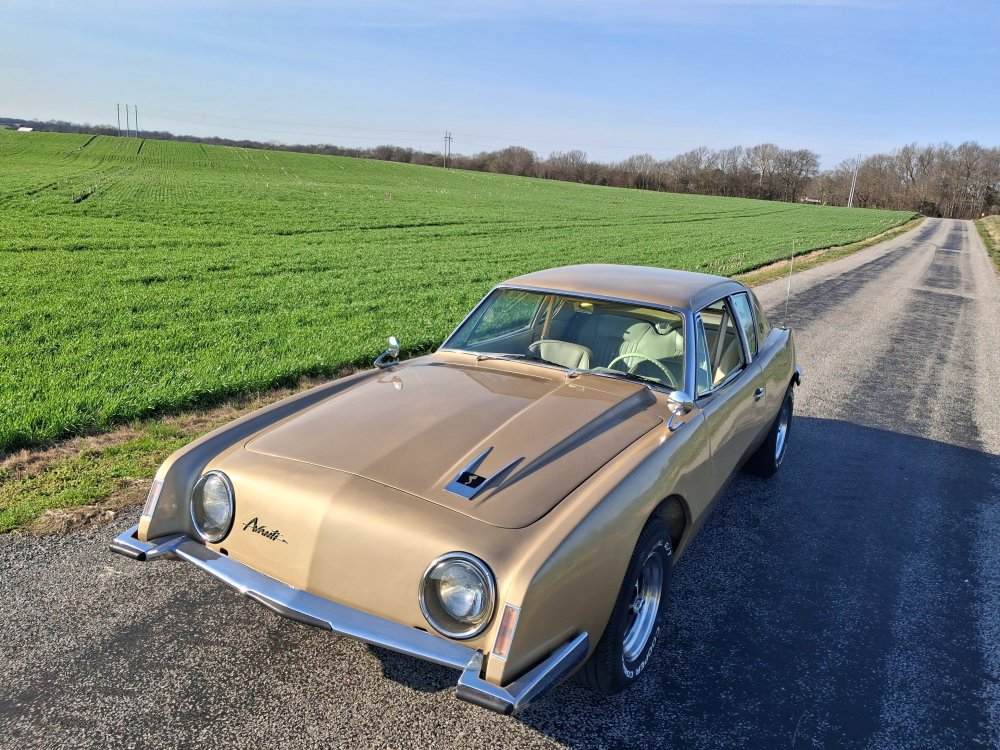
Turned out to be the heat riser installed on the WRONG (drivers) side by the engine rebuilder. It was free, but did not open when heated up. So I took a spring and wired it open. Now she runs like a scalded dog!
-
Ferrari offered to supply engines to Studebaker for the Avanti.
-
In 1962, what was the offer Enzo Ferrari made to Sherwood Egbert shortly before the Avanti was introduced ?